What does a circular future look like for plantation sector?
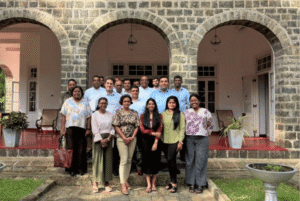
Home / Back What does a circular future look like for plantation sector? We are excited to begin this journey with Horana Plantations PLC, a member of the Hayleys Group,

Home / Back What does a circular future look like for plantation sector? We are excited to begin this journey with Horana Plantations PLC, a member of the Hayleys Group,

Home / Back We facilitated many conversations on circular economy and systems transformation over the years. But Rewire the Economy: A Game-Based Simulation on Developing Circular Transition Roadmaps is unique

Home / Back ntentionally Designing Sustainable Consumption and Production Policies and Practices to Reduce Inequalities What if a policy helps the environment but widens the gap between those who benefit

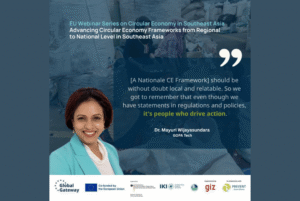
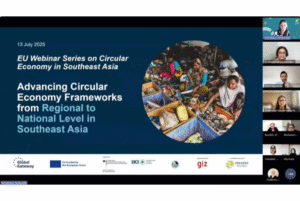
Home / Back Delighted to have contributed to this important dialogue on developing National Circualr Economy Frameworks in Southeast Asia! 🌏 It was wonderful to exchange insights with fellow speakers

Home / Back At times like this, where businesses think more than twice in taking action towards change, we tend to think that it is (mostly) the government influce through regulatory

Home / Back At times like this, where businesses think more than twice in taking action towards change, we tend to think that it is (mostly) the government influce through regulatory

Home / Back Circularity is often visualized as a closed loop. But does a resource really need to return to the same product, process, or industry to be considered circular?

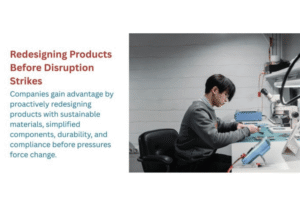
Home / Back Are companies looking at redesigning their products proactively aiming decarbonisation and regeneration opportunities ? If not, why should they? If you continue as is, checking risks on – vulnerability to supply

Home / Back “We can’t afford to shift what we procure to buy sustainable or circular products” when we hear this, the real underlying question is: Can we afford not to? Most procurement teams get stuck in the same loop:

Home / “We want to go circular—but where are the options?” If you’ve tried sourcing sustainable or circular solutions lately, chances are you’ve run into this. – Limited product visibility–

Home / Recycling isn’t enough — here’s what comes next We’ve all seen it. Bins full of “recyclables.” Trucks on the road. Factories breaking materials down. And yet — our

Home / Capability building isn’t just a buzzword. It’s the foundation for a true shift toward a circular economy. Capability building to drive change may mean different things in

Home / We begin life surrounded by gifts, soft toys, tiny clothes, the colors of care. They mark our beginnings, then slowly fade into drawers, boxes, or forgotten corners of

Home / What are the opportunities for the hospitality industry to better design for a circular economy? You might say – Packaging! Yes, it is an opportunity. But what about

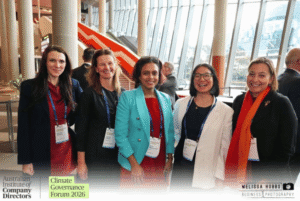
Home / Why Board Buy-In Matters for Sustainability Transformation As organisations prepare for the upcoming Australian Sustainability Reporting Standards (ASRS), many are recognising that real progress on reducing the resource

Home / Every celebration glows bright and fades beneath what it leaves behind. Mountains of wrapping paper, ribbons, and packaging tell a quiet story of what gets unwrapped and left behind.

Home / The Rise of Shared-Use Design What if products created more value after each use, not less? Shared-use models are now emerging as a practical lever for optimising resource

Home / Why Repair Still Matters. We live in a world where upgrading feels easier than repairing. But every time we choose to fix rather than replace, we extend the

Home / Remanufacturing is a growth strategy, not a cost Remanufacturing used to be considered a niche activity—an add-on to traditional production. Today, it’s emerging as a strategic advantage for

Home / Circular Economy Is About Designing Better Systems Repair, refurbishment and remanufacturing are often seen as end-of-life solutions, but in a circular economy, they are part of a much bigger story.

Home / The reality of trade-offs Not all “sustainable” packaging options perform the same—and some fail where it matters most. Many organisations upgrade to new materials without a clear understanding of how

Home / The value of structured decisions without relying on judgment alone In many organisations, complex decisions, such as selecting suppliers, materials, technologies, or investment priorities, are still shaped primarily

Home / Australia’s Environmentally Sustainable Procurement (ESP) Policy is reshaping procurement by emphasizing climate action, environmental protection, and circular economy principles. Effective from 1 July 2024, the policy initially targets

Home / “Circular procurement? Sounds expensive (to consider and to work on)” That’s how you may feel – but the truth is far from this. For many teams, the move

Home / “Oh my god bro, why is there a box, in a box and another box?” This is what I heard from the living hall when my 9-year-old started taking off

Home / Did you know that circular procurement can enhance business competitiveness by creating resilience in your supply chain, driving innovation and designing out waste to save costs? It improves

Home / Newsletter We have good intentions, but do we have what it takes to functionally run a circular economy? How many of us reach the point where our well-functioning

Home / We’ve talked about decarbonisation, and also about a circular economy “But, internally driving these are not enough” “We need to also purchase solutions that actively drive these!” If you’re actively

The project aims to aid RBE to be audit-ready in compliance with Puro.Earth Carbon Removal Standard (2021). The study involved the biomass provider Holla Fresh and biochar user for soil

The project involved taking a deep analytical look at CMTP’s organizational footprint analysis and product footprint analysis of a key strategic key unit (SKU) and proposing, a) Options for continuous

A lot of us are fortunate to enjoy the day following Christmas as a holiday, and in Commonwealth countries we call it the “Boxing Day”. The history of boxing day

Given that we only require a certain amount of energy per day, why have our portion sizes continued to increase over time? Portion sizes have been progressively increasing over the

Image by Jeff Juit from Pixabay A message to buy less from a producer is quite rare and far from the norm. Usually, when we are browsing for a new product, we are